
Jean Junkala
The unique motif formed by weaving threads of pastels has given Jean Junkala her own distinguishable style and set her apart in her field. This technique was developed as a way to represent the interplay of light as it is reflected, absorbed, split, diffracted and recombined in nature — to be optically mixed within each viewer's eyes.
Born in Ohio, Jean received formal education in fine arts at Wright State University and at the Baum School of Art in Pennsylvania.
Her works have been exhibited at the National Arts Club gallery in New York City, across North America and France. She is part of several important collections, including the Loto Quebec Collection.
#JJA-2026 · Est. 1996Curatorial Statement
Why paint in strings?
It is interesting to watch the reaction of visitors to an art gallery as they notice and then approach one of Jean Junkala paintings. First, they approach, slow down, pause and then walk backwards to where they came from. The process is often repeated in what Jean likes to refer to as her colour dance.
Jean's technique builds upon the work of the post-impressionist who developed an innovative way to depict form and create illusions of depth, not through changes in values or through the use of shadow effects, as had traditionally been done, but through an innovative way to represent and use colour. Such efforts have been generally associated with the work of the pointillists. One drawback was that this technique did not easily land itself to the depiction of movement and volume but their studies and application of colour principles formed the basis of a new technique that, nearly 100 years later, would attempt to remedy these limitations.
Jean Junkala paints in what could be described as colour strings. Whereas Seurat, a leading pioneer of this new approach to painting, would painstakingly position dots of paint to achieve his recognizable optical mix of colours, Jean creates a complex weave of sinuous colour strokes to attain the same effect using pastels, her medium of choice. Soft pastels, applied in numerous layers of pure colours, allows her to produce the long strokes necessary to create a virtual mesh. It is something pointillists achieved using oil based paint or most other medium.
Looking at Jean's work for the first time it will be clear that it is immediately recognizable, unique and engaging but how does it relate to the use of colour in painting? It is important to note that the differences between the two techniques are not limited to the use of strings rather than the use of small dots. Seurat often insisted that divisionism, his preferred term for his technique, was not about the use of dots, but really about colour contrasts.
Pointillism, in fact, resides in the systematic use of pure complementary colours, juxtaposed and in close relationship to each other, creating an optical blend of colours once the viewer takes some distance from the canvas. While the optical recomposition created by Seurat was not as perfect as what we now see in colour printing or on TV screens, which use the same principles, the divisionists clearly demonstrated that pure colours could be mixed optically, resulting in a rich and varied palette.
The divisionists attempted through the use of simultaneous construct of complementary colours to maintain or even increase the intensity of each colour while using paint. The effect was, to some extent, limited as to the minimum size of that they could produce without mixing with the adjoining dots.
Signac reported being horrified when adjacent dots of paint would touch creating what he called a disgusting looking mud where the pigments would cancel each other in a subtractive colour mix to produce a dull gray. In fact, almost all colour mixing occurs in a subtractive manner. Every time an artist blends two or more paints the resulting colour is always inferior in luminosity and intensity.
Pastels have allowed Jean to work with one of the purest and most direct painting medium even though she recognized that pastels have important limitations. First, pastels are an opaque medium, which makes it difficult to mist or glaze a colour over another. It also does not easily lend itself to working in layers. Also since pastel has almost no binder, it must be done on a rough surface, which holds only up to a certain amount of pigment, known as the tooth of the paper.
Experimenting with pastels Jean discovered that by painting with a complex weave of colour strings, she could achieve the complex effects of transparency, volume and movement. Jean was able to create movement and perspective through layering and simply closing or opening the weave. She recognized immediately that the new technique had a lot of potential for achieving the smooth optical colour mixing the pointillists were seeking.
The opacity of pigments in pastels, a handicap when trying to create transparency effects, becomes an advantage when Jean was tracing long crisscrossing strokes of pure primary and opposite colours that retain their full intensity without mixing on the canvas, leading to a true and intense optical mix.
This is true up to a point. Once the canvas becomes saturated, especially when pastels of similar hardness cross, it may eventually limit the ability to add colour strokes. Consequently, one of the important difficulties with this technique is that errors are very difficult to correct. Using more than a dozen types of pastels of different hardness helped Jean to deal with this limitation.
But what made Jean persevere with her unique and distinctive technique is the ability, playing with the placement and choice of strokes, to pull and push form creating strong perspective or in other cases transparency. Interestingly, this perspective does not reveal itself until the viewer takes the appropriate distance where the colours mix optically. From close, the viewer sees what appears to be a random and abstract placement of lines that look like balls of yarn without in many cases being able to recognize what is represented on the canvas. As they move away, the magic is revealed and looks of awe generally develop. This is when one begins to dance forward to see the details, backward to see the results and then again.
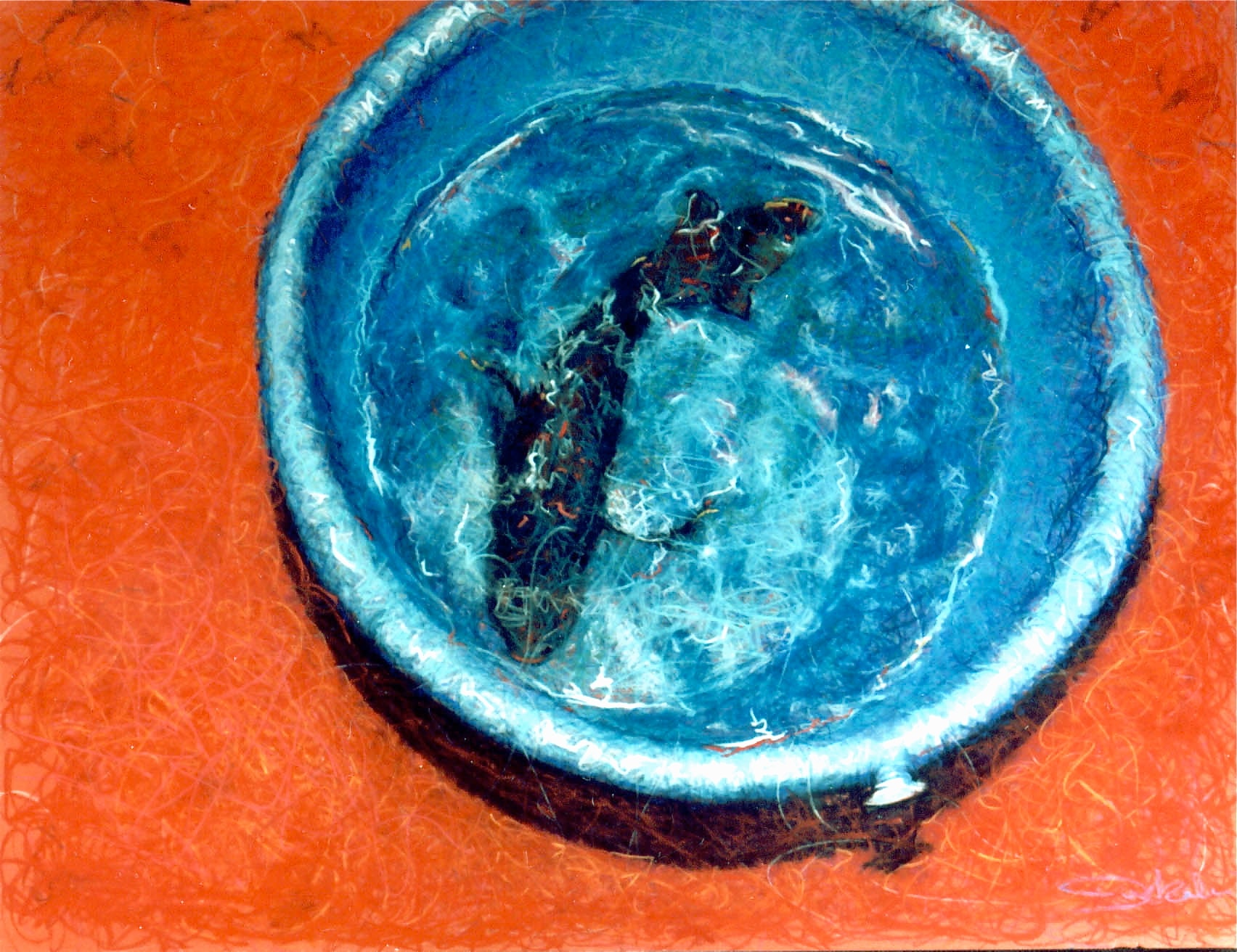
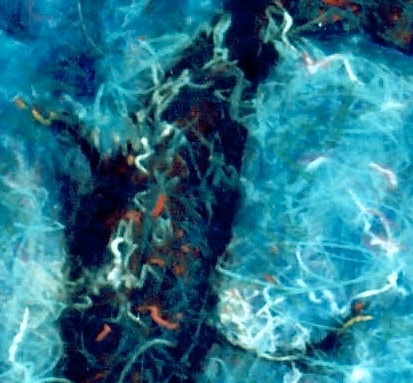
Jean feels that in nature colours bounce around being reflected here, absorbed there and evolve constantly as natural light changes. Her technique allows her to represent light as it behaves in the real world. By layering pure colours in multiple layers, she could create an interior glow that few techniques can achieve. An important benefit of the technique is that Jean can change the feeling of a painting, for example, by placing a loose layer of yellow to change the temperature of the sky, without even having to paint over it, losing some of its luminosity.
Her technique also builds on Jean's vision that to truly appreciate the work of painters, the work has to be viewed from a close distance, at arm's length, to appreciate what the painter was seeing as he was applying the medium to his canvas and then move back to appreciate the final product that the artist wanted to create. That is especially true for the impressionists and post-impressionists who relied extensively on optical colour mixing which require some distance to allow the colours to blend and for the perspective and form to then be created.
While some viewers will only see colour strings, just as 100 years ago most only saw dots, what Jean has achieved with her pastel strings is recognizably a significant evolution of colour division principles in painting. It takes a fragile and opaque medium and opens possibilities for representing perspective, transparency and movement and takes advantage of the richness and full intensity of pastels.